The Ground Beneath Your Gear: How Platforms and Isolation Change Everything You Hear
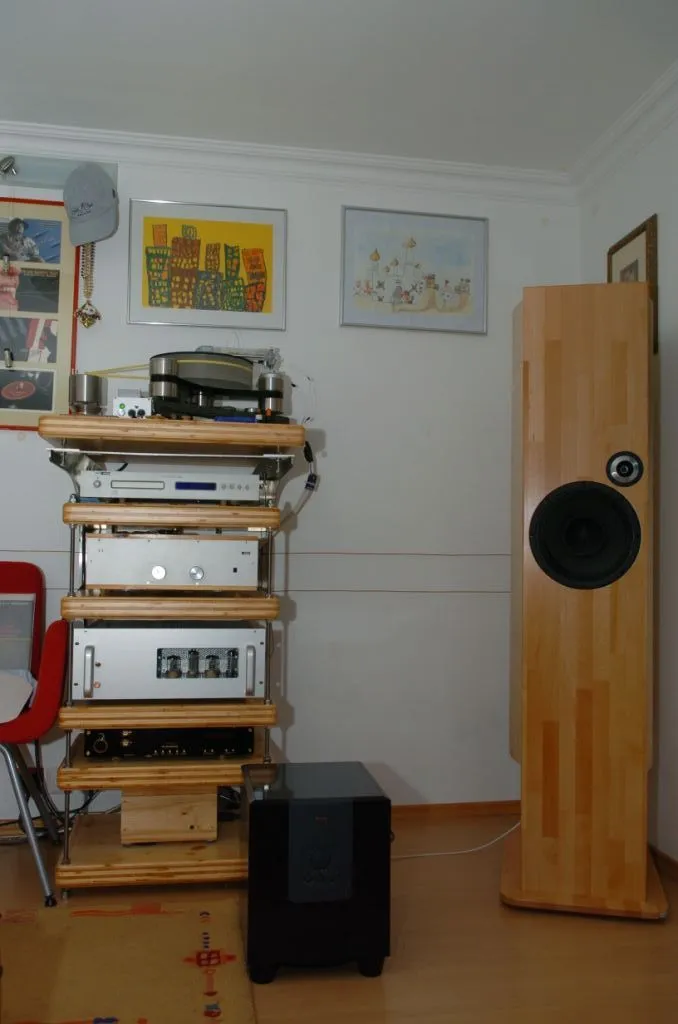
Photo: Dieter Karner from Roggendorf (Schollach), Austria, CC BY 2.0, via Wikimedia Commons
There is a particular kind of frustration reserved for the audiophile who has done everything right. The amplifier is excellent. The speakers are carefully chosen. The cables are properly dressed and terminated. The room has been treated. And yet, something remains slightly wrong — a softness in the transients, a smearing of low-level detail, a high-frequency edge that refuses to fully resolve. The culprit, more often than not, is sitting in plain sight: the shelf, rack, or floor surface on which the equipment rests.
Vibration is among the least glamorous topics in high-fidelity audio, which is precisely why it is so frequently neglected. The physics, however, are unambiguous. Every component in a playback chain — from a turntable cartridge to the enclosure of a loudspeaker — is susceptible to mechanical energy. That energy does not stay where it originates. It travels.
The Physics of Unwanted Motion
When a loudspeaker driver moves, it does not merely push air toward the listener. It also pushes backward against the cabinet, which in turn transfers energy into whatever surface supports it. That surface — whether a hardwood floor, a carpeted slab, or a glass-shelved rack — responds by vibrating in sympathy. Those sympathetic vibrations then reenter the cabinet, interact with the driver's motion, and introduce low-level distortions that no amount of equalization can correct after the fact.
For electronics, the mechanism is somewhat different but equally consequential. Transformers hum at line frequency. Hard drive platters in digital transports spin at thousands of revolutions per minute. Vacuum tubes, famously microphonic, respond to airborne and structure-borne vibration by modulating the electron stream within them. Even solid-state components are not immune: capacitors and resistors exhibit piezoelectric behavior under mechanical stress, generating minute but measurable spurious voltages.
The cumulative effect of these interactions is a form of distortion that does not show up cleanly on a frequency response graph. It manifests instead as a subtle blurring of the soundstage, a compression of dynamic contrasts, and a general sense that the system is working slightly against itself.
What Isolation Actually Means
The term "isolation" is used loosely in the audio industry, and that looseness has generated considerable confusion among consumers. True isolation — decoupling a component from its support surface so that vibration cannot transfer efficiently in either direction — requires a mechanical discontinuity. The most common approach is compliance: inserting a material between the component and the surface that absorbs or redirects vibrational energy rather than transmitting it.
Foam pads, rubber feet, and gel-based isolators all operate on this principle. Their effectiveness depends on the relationship between the mass of the component being supported and the resonant frequency of the isolating material. A compliant pad that works beautifully beneath a 60-pound amplifier may do essentially nothing under a 4-pound DAC. This is why generic foam pads sold as universal solutions so frequently disappoint: the physics of vibration isolation are not universal.
A competing approach is constrained-layer damping, in which a viscoelastic material is sandwiched between two rigid layers. Energy entering the structure is converted to heat through shear stress within the viscoelastic layer. Well-designed equipment platforms using this principle — typically a combination of materials such as MDF, aluminum, and a proprietary damping compound — can be remarkably effective across a wider range of component masses than simple compliance-based solutions.
The Stand Question
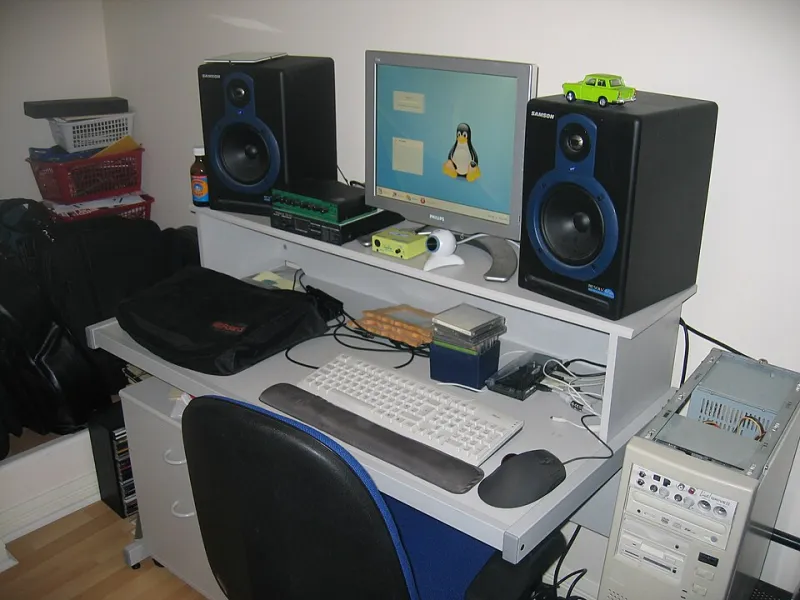
For loudspeakers, the support structure deserves particular scrutiny. A bookshelf speaker placed directly on a shelf is, in a very literal sense, acoustically coupled to every object that shelf also supports. A dedicated speaker stand, properly designed and appropriately filled, provides both the correct listening height and a degree of mechanical isolation that a shelf cannot replicate.
Stand filling — typically sand, lead shot, or a combination — increases the stand's mass and raises its resonant frequency above the range of musical content. This approach is well-established and genuinely effective. However, the interface between the stand's top plate and the speaker cabinet introduces its own variables. Hard-spiked coupling, which transfers energy into the stand rather than reflecting it back into the cabinet, is preferred by many manufacturers. Compliant interfaces — thin rubber or foam gaskets — take the opposite approach, interrupting the transfer path entirely. Neither solution is universally superior; the correct choice depends on the specific speaker, the stand's construction, and the floor surface beneath.
Premium Platforms: Justified or Merely Expensive?
The high-end audio market offers isolation platforms ranging from fifty dollars to several thousand. The honest answer to whether the premium products justify their cost is: sometimes, and not always for the reasons their manufacturers claim.
Products from established brands that have invested in genuine engineering — demonstrable resonant frequency measurements, verified damping coefficients, materials chosen for acoustic rather than aesthetic reasons — frequently deliver audible improvements that less expensive alternatives cannot match. The difficulty lies in distinguishing these from products whose pricing reflects marketing narrative rather than mechanical performance.
A useful test is specificity. A manufacturer who can tell you the resonant frequency of their platform, the mass range it is optimized for, and the mechanism by which it achieves isolation is almost certainly selling a real product. A manufacturer whose literature speaks exclusively of "micro-vibration elimination" and "quantum-level resonance control" without quantifiable claims is asking you to buy a story.
In controlled listening sessions conducted across multiple systems at Hawthorne Audio, purpose-built constrained-layer platforms consistently outperformed both bare equipment racks and generic isolation pads when placed beneath digital sources and preamplifiers. The improvements were not dramatic in absolute terms — this is not the kind of upgrade that transforms a mediocre system into a reference-quality one. But in systems already operating at a high level, the reduction in high-frequency grain and the improvement in low-level detail retrieval were consistent and repeatable.
Beneath loudspeakers, quality dedicated stands with appropriate filling produced more consistent improvements than any aftermarket isolation device placed between the speaker and an existing shelf. The fundamental argument for purpose-built stands is not merely acoustic; it is architectural. A speaker positioned at the correct height, decoupled from shared shelf mass, simply operates in a more favorable mechanical environment.
Practical Priorities
For those reassessing their current setups, a rational sequence of priorities would begin with speaker stands if bookshelf monitors are resting on furniture. The improvement here is typically the most significant and the most immediately audible. Next, attention should turn to the support beneath analog sources — turntables and phono stages are acutely sensitive to structure-borne vibration in ways that digital components generally are not. Finally, equipment platforms beneath digital sources and amplifiers represent a worthwhile investment for systems that have already addressed the more fundamental variables.
The temptation to dismiss vibration control as audiophile mythology is understandable. The claims made by some manufacturers are, frankly, implausible. But the underlying physics are not in dispute, and the improvements available through thoughtful isolation practice are genuine. The question is not whether vibration affects your system. It does. The question is whether you are addressing it systematically or leaving sonic performance on the table — and on the shelf.