The Six-Inch Secret: How Microscopic Speaker Adjustments Produce Macroscopic Sonic Transformations

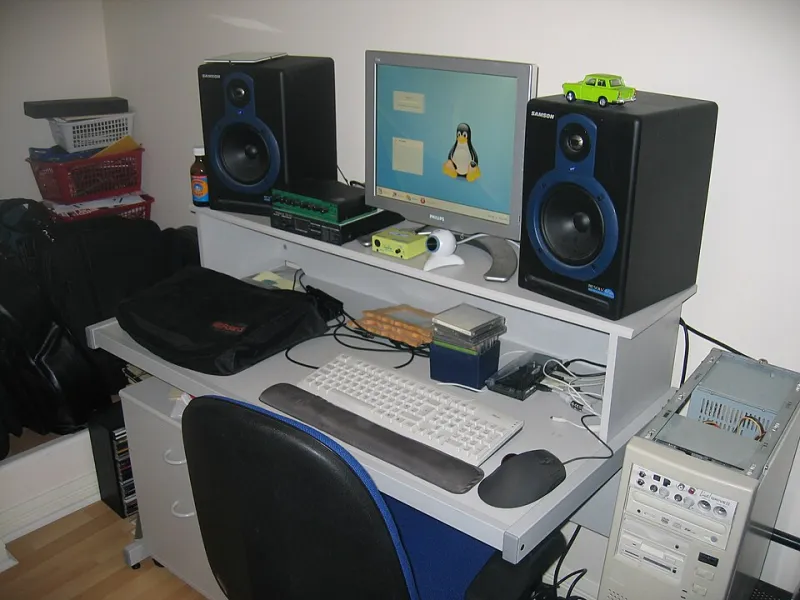
Photo: Robertromejr, CC BY-SA 4.0, via Wikimedia Commons
There is a ritual that takes place in professional recording studios across the United States that most home listeners never witness and rarely consider. Before a single mix decision is made, before a single fader is touched, the studio engineer verifies the position of every monitor in the room with a precision that borders on obsessive. Tape measures appear. Laser levels emerge. Listening positions are confirmed to within fractions of an inch. The reason is not perfectionism for its own sake. It is because these professionals understand something that the consumer audio world has largely failed to communicate: speaker placement is not a preliminary step before the real work begins. It is the real work.
For the home listener who has just invested in a serious pair of loudspeakers, the instinct is to place them where they look right, where they fit the furniture arrangement, or where the speaker cables happen to reach. These are entirely understandable priorities. They are also, from a purely acoustic standpoint, the wrong ones.
Why Small Distances Carry Enormous Consequences
To understand why a six-inch movement changes so much, you first need to understand what sound is actually doing inside your listening room. When a speaker produces a sound wave, that wave does not travel cleanly from the driver to your ear in a straight line. It travels in every direction simultaneously, reflecting off walls, floors, ceilings, and every hard surface in the space. Your ear receives not one signal but dozens — the direct wave from the driver followed by a cascade of reflections arriving milliseconds later from different angles.
The relationship between the direct sound and these early reflections determines, to a remarkable degree, everything you perceive about the sonic character of the system: the width of the soundstage, the precision of instrument placement within it, the sense of depth, and the evenness of the bass response across the listening position. Move the speaker six inches closer to a side wall, and you have fundamentally altered the arrival time and amplitude of the first lateral reflection. Move it six inches toward a rear wall, and you have changed the boundary loading that reinforces or distorts low-frequency output. These are not subtle adjustments. They are structural changes to the acoustic environment your speaker is operating within.
The Boundary Effect and the Bass Trap You Did Not Buy
One of the most immediately audible consequences of poor speaker placement involves the interaction between woofer output and room boundaries. When a speaker sits close to a wall — particularly a rear wall — the reflected bass energy from that surface arrives at your listening position slightly after the direct sound. Depending on the frequency involved and the distance to the boundary, this reflection can arrive in phase with the original signal, boosting certain bass frequencies by several decibels, or out of phase, creating a cancellation null that hollows out the low end in ways no amount of equalization can fully correct.
Audiophiles who complain that their system sounds "boomy" or "one-note" in the bass, or conversely that it sounds thin and lightweight despite their speakers' measured low-frequency extension, are frequently experiencing exactly this phenomenon. The fix is not a new subwoofer or a different amplifier. The fix is often moving the speakers forward from the rear wall by a foot or two and carefully listening for the point at which the bass response becomes the most even and articulate. This process takes time. It takes patience. It frequently requires temporarily rearranging furniture. It costs nothing.
Toe-In, Imaging, and the Disappearing Speaker Trick
Beyond distance from boundaries, the rotational angle of a speaker — its toe-in — exercises a surprisingly powerful influence over the perceived soundstage. A speaker aimed directly forward, parallel to the side walls, delivers a broad but often diffuse stereo image. A speaker toed in sharply toward the listening position narrows the soundstage but sharpens image focus, placing instruments and voices with greater precision in the stereo field. The optimal angle sits somewhere between these extremes, and it varies by speaker design, room geometry, and listener preference.
The phenomenon that experienced listeners describe as a speaker "disappearing" — the sense that sound is emanating from a three-dimensional space rather than from two physical boxes — is almost entirely a function of this balance between direct radiation and room interaction. Achieving it requires systematic experimentation. Begin with the speakers toed in so that their axes cross slightly in front of the listening position. Listen carefully to a familiar recording with a well-defined center image — a solo vocal, a mono instrument. Adjust the toe-in in small increments, listening each time for the sharpness and stability of that central image. When the image snaps into focus and appears to float between the speakers with no gravitational pull toward either cabinet, you have found a productive starting point.
The Equilateral Triangle and Its Limits
The most commonly cited starting point for speaker placement is the equilateral triangle: position the two speakers and the listening chair at the three points of an equilateral triangle, with the distance between the speakers equal to the distance from each speaker to the listener. This is sound advice as a baseline. It is not, however, a destination.
The equilateral triangle assumes a symmetrical room with uniform acoustic properties, which describes very few actual American living rooms. Asymmetrical furniture arrangements, openings to adjacent rooms, bay windows, and built-in bookshelves all introduce acoustic irregularities that the equilateral triangle cannot account for. Real-world placement requires treating the triangle as a hypothesis to be tested rather than a rule to be followed. Small deviations from the formula — shifting one speaker slightly, adjusting the listening position forward or back — can yield improvements that no formula predicts.
The Experiment You Should Conduct This Weekend
Consider approaching your listening room as a studio engineer would approach an unfamiliar control room. Begin by measuring your current speaker positions relative to all room boundaries and documenting them. Then, over the course of several sessions, make single-variable adjustments: move both speakers forward from the rear wall in two-inch increments, listening after each change. Then experiment with toe-in. Then adjust the distance between the speakers. Keep notes. Use familiar recordings you know intimately — recordings you have listened to on headphones, in the car, at a friend's home — so that you have a reliable reference for what the music should sound like.
What you will discover, almost certainly, is that there exists a range of positions within your room where the system sounds substantially better than it does elsewhere. You may also discover that your current arrangement, arrived at through aesthetics or convenience, is not within that range.
The Upgrade You Have Been Overlooking
The audio industry is built on the premise that better sound requires better equipment. There is truth in this. But it is an incomplete truth that conveniently obscures the degree to which placement optimization can outperform component upgrades costing many hundreds or thousands of dollars. Professional studio monitors costing a fraction of high-end consumer loudspeakers, positioned with care and precision, routinely outperform far more expensive equipment placed carelessly.
The next time the impulse arises to upgrade a component in search of better sound, spend one weekend first with a tape measure, a listening chair, and a willingness to move things around. The improvement you have been purchasing may have been available all along, sitting six inches away from where your speakers currently stand.