Closer Is Not Better: The Uncomfortable Truth About Desktop Speaker Listening
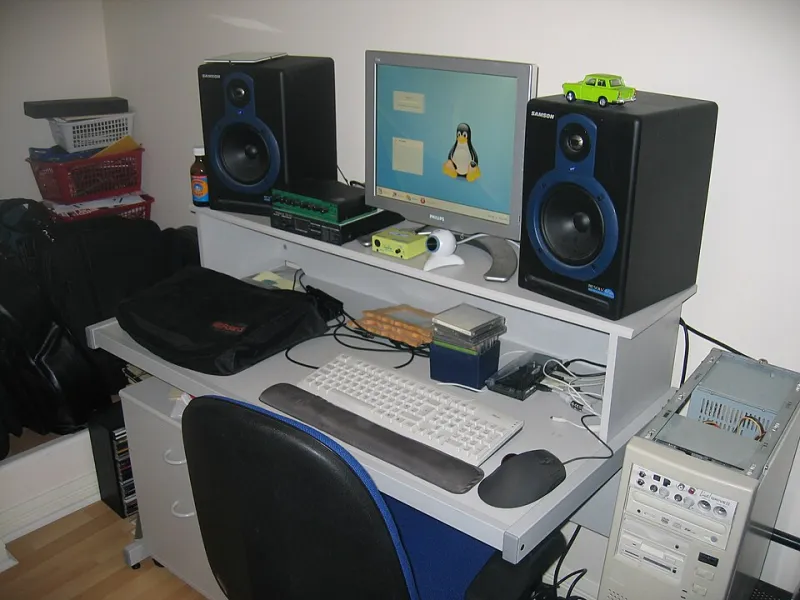
Photo: Tim Walker, CC BY 2.0, via Wikimedia Commons
There is a seductive logic to the desktop audio setup. You are close to your speakers. The sound arrives before the room has a chance to interfere. You have eliminated, or so the thinking goes, the single greatest enemy of high-fidelity reproduction: the listening environment itself. What could possibly go wrong?
Quite a lot, as it turns out.
Nearfield listening — the practice of positioning speakers within roughly three to four feet of the listener — is not inherently superior to a properly configured full-room setup. It is simply different. And that difference carries consequences that the majority of desktop audiophiles never fully reckon with. Understanding those consequences is the first step toward building a desktop system that actually delivers on its considerable promise.
What "Nearfield" Really Means Acoustically
The term nearfield has a precise meaning in acoustical engineering. When you are positioned within the nearfield of a speaker, you are receiving a higher ratio of direct sound to reflected sound than you would at greater distances. This is the arrangement's primary appeal: the room contributes less, and the speaker contributes more.
But the nearfield is not a reflection-free zone. It is simply a zone where early reflections — those arriving within roughly 20 milliseconds of the direct signal — arrive with less energy than they would at conventional listening distances. Those reflections still exist. And in a desktop environment, they arrive from surfaces that are unavoidably, sometimes aggressively close.
Your desk surface is the most significant offender. A hard wooden or glass desktop positioned directly beneath your speakers acts as an acoustic mirror, bouncing midrange and high-frequency energy directly toward your ears a few milliseconds after the direct signal. The result is a phenomenon called comb filtering: a series of frequency peaks and nulls that color the sound in ways that no amount of equalization can fully correct, because the interference pattern shifts every time you move your head.
The Room Mode Problem Does Not Disappear — It Shrinks
One of the more persistent myths in desktop audio is that small rooms and short listening distances eliminate the low-frequency room mode problem. They do not. They relocate it.
Room modes — the resonant frequencies at which a room's dimensions cause standing waves — exist in every enclosed space. In a standard American living room, these modes typically manifest below 300 Hz, with the most troublesome peaks and nulls concentrated in the 40–120 Hz range. In a small home office or bedroom, those same modes are compressed into a narrower and often more severe pattern. The room is not too small to have modes. It is too small to have comfortable modes.
When you add a desk into this equation, you introduce a secondary resonant structure. Desks vibrate. They transmit energy. A speaker sitting directly on a desktop will couple mechanically with that surface, exciting resonances in the desk itself and muddying the bass response in ways that are distinct from both the speaker's own character and the room's modal behavior.
Decoupling your speakers from the desk surface — through purpose-built isolation pads, dense foam, or aftermarket stands — is not an audiophile affectation. It is a basic acoustic necessity.
Speaker Selection Changes Entirely at Close Range
A speaker optimized for a ten-foot listening distance behaves differently at three feet. This is not a minor distinction. At short distances, the individual drivers in a two-way or three-way speaker have not yet fully integrated their output into a coherent wavefront. You are, in effect, sitting inside the crossover region — close enough that the tweeter and woofer can be heard as separate sources rather than a unified acoustic event.
This is why monitor speakers designed for professional studio use — where engineers routinely sit within arm's reach of their reference system — are built with narrower baffles, carefully time-aligned drivers, and crossover points specifically calculated for near-distance coherence. The same qualities that make a large floorstanding speaker magnificent at ten feet can make it congested and incoherent at three.
For the desktop audiophile, this means that speaker selection cannot be driven by specifications alone. Dispersion characteristics matter enormously. A speaker with wide, uncontrolled horizontal dispersion will flood your desk surface with reflected energy. A speaker with a tightly controlled, waveguide-assisted dispersion pattern will direct more energy toward your ears and less toward the reflective surfaces surrounding them.
Treating a Desktop Environment: Practical Strategies
Full acoustic treatment of a small office or bedroom is neither practical nor aesthetically acceptable for most people. The good news is that targeted, strategic treatment of the specific reflection points that matter in a nearfield context can yield substantial improvements without transforming your workspace into a recording studio.
The desk surface. This is your first priority. A large acoustic pad, a thick book, or even a folded moving blanket positioned beneath and in front of each speaker will absorb the first reflection that would otherwise arrive at your ears as a slightly delayed copy of the direct signal. Dedicated desktop speaker isolation pads serve both this damping function and the mechanical decoupling function described earlier.
The wall behind the speakers. In a desktop setup, this surface is often only a foot or two behind the speakers themselves. Early reflections from a hard wall at this distance arrive almost simultaneously with the direct sound, effectively smearing the stereo image and reducing perceived clarity. A modest acoustic panel — even a thick tapestry or a bookshelf densely packed with books — positioned on this wall will address the problem without requiring permanent installation.
The ceiling. Often overlooked, the ceiling above a desktop listening position is a significant reflection point, particularly for high-frequency content. If your ceiling is low and hard, a small diffuser or absorptive panel positioned directly overhead will improve imaging stability considerably.
Toe-in and height. Speaker placement in a nearfield context is unusually sensitive. Toe-in angle affects not only the stereo image but the intensity of desk-surface reflections. Positioning your speakers so that the tweeters are aimed slightly above ear level — rather than directly at your ears — reduces the direct high-frequency energy striking the desk in front of you, while maintaining acceptable frequency response at the listening position.
The Apartment Audiophile's Realistic Path Forward
For the millions of American audiophiles living in apartments, condominiums, and small homes where a dedicated listening room is simply not available, the desktop setup is not a compromise — it is the primary listening environment. Treating it as such, rather than as a secondary system deserving less attention, is what separates genuinely satisfying desktop audio from a collection of expensive equipment that never quite sounds right.
The investment required to address nearfield acoustic problems is modest relative to the cost of the equipment those problems are undermining. A pair of quality isolation pads, a small absorptive panel, and careful attention to speaker placement and toe-in angle will do more for the perceived quality of a desktop system than a cable upgrade, a new DAC, or any number of other expenditures that audiophiles routinely prioritize.
Proximity to your speakers is an opportunity. But like most opportunities, it demands that you understand its terms before you can take full advantage of them.