Powered Down, Sounding Different: The Truth About Capacitors and Amplifier Warm-Up
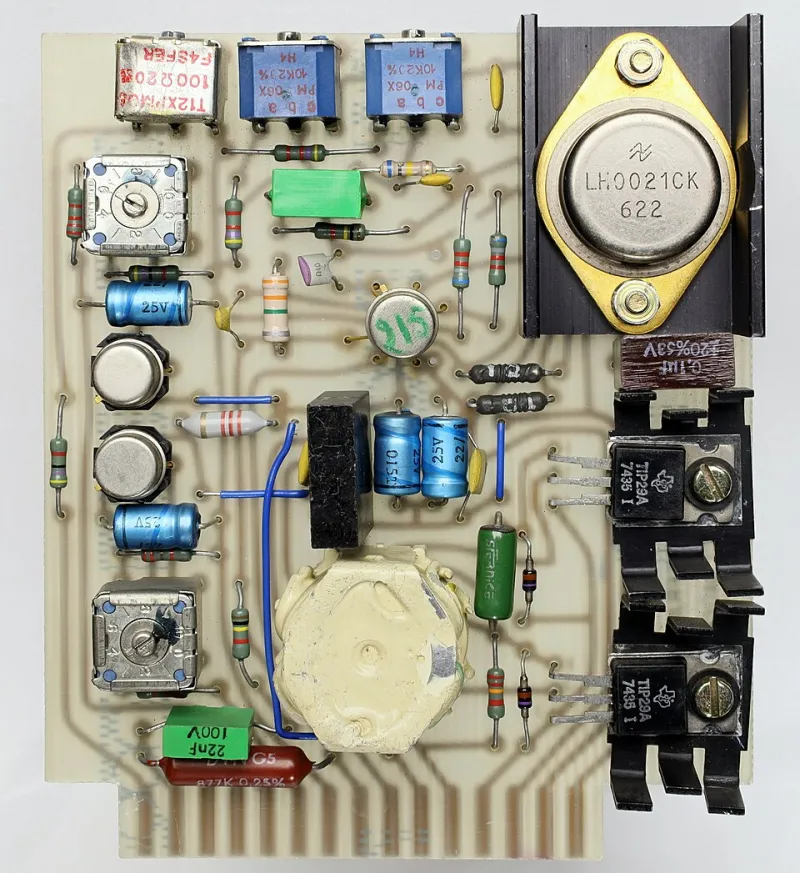
Photo: Mister rf, CC BY-SA 4.0, via Wikimedia Commons
Among the more persistent conversations in audiophile circles is one that sounds, on its surface, almost too esoteric to take seriously: the idea that an amplifier left unplugged for an extended period — a week, perhaps, or a month after a cross-country move — will sound meaningfully different upon first power-up than it will after several hours of operation. Some listeners describe the initial sound as thin, slightly compressed, or lacking in low-frequency authority. Others claim the difference is dramatic enough to be immediately apparent. A few insist there is no difference at all.
What separates this discussion from purely anecdotal territory is that the underlying electrical phenomenon is entirely real. Capacitor reformation is not an audiophile myth. It is a documented characteristic of electrolytic capacitors — components found in virtually every amplifier power supply ever manufactured — and understanding what it actually does, and does not do, is essential for anyone who wants to reason clearly about the sound of their equipment.
What Electrolytic Capacitors Actually Do Over Time
Electrolytic capacitors function by maintaining a thin oxide layer on an aluminum foil surface. This layer acts as the dielectric — the insulating barrier that gives the capacitor its ability to store charge. When a capacitor is manufactured and first formed at the factory, this oxide layer is grown under controlled conditions using a precise voltage application process.
The complication arises from the fact that this oxide layer is not permanently stable. In the absence of applied voltage over extended periods, the layer can partially degrade. The capacitor does not fail outright, but its electrical characteristics shift in measurable ways. Leakage current increases. The effective capacitance may drift. In extreme cases — capacitors that have sat unused for years in vintage equipment — the degradation can be severe enough to cause audible distortion or even component failure upon abrupt re-energization.
Reformation is the process by which that oxide layer is gradually restored. When voltage is reapplied, particularly if done incrementally using a variac or similar tool, the oxide layer rebuilds itself. For most modern amplifiers that have been unplugged for days rather than years, this process is far less dramatic — but it is not nothing.
The Week-Long Rest: What the Measurements Say
For an amplifier that has been powered down for a week in a temperature-stable environment, the measurable impact of capacitor degradation is typically modest. The power supply capacitors in a well-designed modern amplifier are not going to exhibit catastrophic oxide breakdown in seven days. What engineers and technicians do observe, however, is a period during which the amplifier's electrical behavior is not fully stabilized — the operating temperatures of semiconductors and passive components have not yet reached thermal equilibrium, and the power supply is still settling into its characteristic operating state.
Measurements taken during this warm-up window — generally the first fifteen to forty-five minutes of operation, depending on the amplifier's design and the ambient conditions — can show subtle but real differences in parameters such as DC offset, channel balance, and harmonic distortion. These are not always large numbers. In a competently designed amplifier, they are unlikely to exceed the threshold of audibility under most listening conditions. But the changes are present in the data, which means dismissing the entire phenomenon as pure imagination does a disservice to the underlying physics.
The more contentious claim — that an amplifier sounds noticeably different after one week unplugged versus one day unplugged — is considerably harder to support with measurements. At that timescale, the dominant variable is thermal stabilization, not oxide reformation, and the two scenarios should reach the same stabilized state after an equivalent warm-up period.
Why Experienced Listeners Remain Convinced
The audiophile community's persistent belief in post-rest sonic changes is not simply a matter of wishful thinking, though expectation bias is almost certainly a contributing factor. Several legitimate variables complicate any informal home listening assessment.
First, the conditions under which a system is auditioned after an extended rest period are rarely controlled. Room temperature may have changed. The listener's own hearing acuity varies throughout the day and across days. Fatigue, stress, and even dietary factors influence auditory perception in ways that are well-documented in psychoacoustic research. A listener who powers up their system after a week away is also, almost by definition, in a different psychological state than they were during their last listening session — often more attentive, more curious, and therefore more likely to notice and interpret small differences.
Second, there is the question of what exactly is being compared. When a listener reports that their amplifier sounded different on Monday morning after a week away than it did on Friday evening before departure, they are performing a memory-based comparison across a seven-day interval. Human auditory memory is not a high-fidelity recording. The comparison is inherently unreliable, regardless of how experienced the listener may be.
None of this means the listener is wrong that something changed. It means the causal attribution — capacitor reformation specifically — is difficult to isolate from the many other variables at play.
Practical Implications for the Serious Listener
For those who own amplifiers with large-value electrolytic capacitors — particularly vintage or high-powered designs where the power supply capacitors may be decades old — the reformation question carries genuine practical weight. Powering up old equipment abruptly after extended storage can stress degraded capacitors, and a slow, incremental power-up using a variac is a standard practice among restoration technicians for good reason.
For owners of modern, well-maintained amplifiers in regular use, the concern is far less pressing. A week of storage in a climate-controlled listening room is unlikely to produce any meaningful capacitor degradation. The more useful habit is simply allowing the amplifier adequate warm-up time before critical listening — a practice supported by both measurement data and manufacturer recommendations across virtually every serious audio brand.
A warm-up period of thirty minutes to an hour is a reasonable baseline for most solid-state designs. Tube amplifiers, with their additional thermal mass and the behavior of thermionic valves, often benefit from longer settling periods. Neither scenario requires a mythology around capacitor conspiracy to justify the practice — the thermal physics alone are sufficient.
Separating the Science From the Story
The capacitor reformation narrative persists in part because it offers a satisfying technical explanation for a subjective experience that listeners find genuinely compelling. It is more satisfying to attribute a perceived sonic improvement to a specific electrochemical mechanism than to acknowledge that the improvement may be primarily perceptual in origin.
At Hawthorne Audio, we believe that honest engagement with audio science means holding both possibilities simultaneously: the electrical phenomenon is real and worth understanding, and the subjective reports of experienced listeners deserve respectful consideration rather than reflexive dismissal. What the evidence does not support is the confident assertion that a week-old power cycle produces a reliably audible, measurable degradation in a modern amplifier under normal operating conditions.
Warm up your equipment. Give it time to stabilize. Listen with patience and without preconception. These are good practices regardless of what the capacitors are doing — and they are likely to serve your listening sessions far better than any amount of theoretical debate about oxide layer dynamics.