Wired for Belief: The Neuroscience Behind Why Audiophiles Swear by Expensive Cables
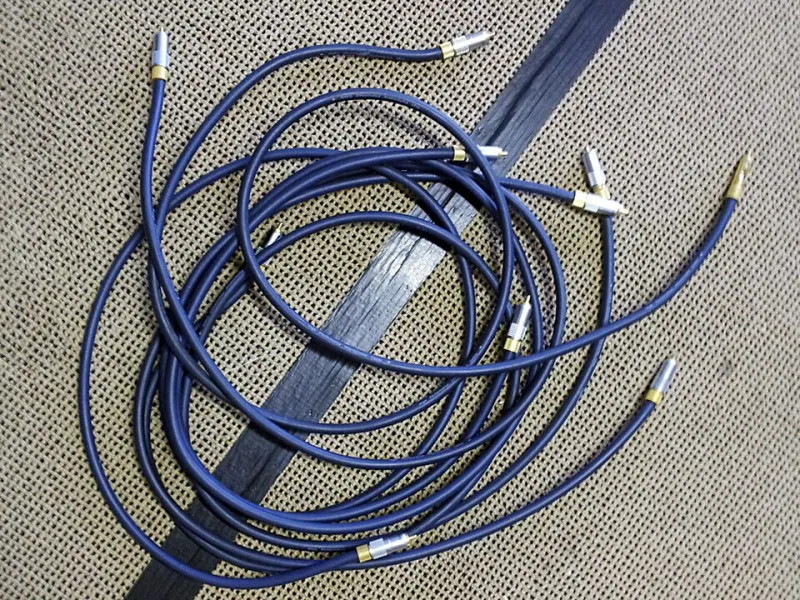
Photo: Jacques from Cape Town, South Africa, CC BY 2.0, via Wikimedia Commons
The Most Persuasive Salesman in the Room Is Inside Your Head
Walk into any serious audio showroom in the United States and you will encounter a wall of cables — some priced modestly, others carrying tags that rival entry-level amplifiers. The sales pitch is seductive and consistent: better materials, tighter tolerances, superior signal integrity. And the customer who just spent four figures on a new integrated amplifier is already primed to believe it.
That priming is not a character flaw. It is biology.
The human brain does not passively receive sensory information and report it faithfully. It constructs experience, filling gaps, resolving ambiguity, and — critically — conforming perception to expectation. Neuroscientists call this predictive processing. Audiophiles, when it happens to them, call it a revelation. Skeptics call it something less charitable. The truth, as usual, sits in a more interesting place than either camp prefers.
What Blind Tests Actually Reveal
The controlled blind listening test is the most powerful tool available for separating genuine sonic differences from psychological artifacts. When listeners cannot see which cable is in use, the results tend to be humbling.
In repeated double-blind studies conducted by audio researchers over the past three decades — including several published in the Journal of the Audio Engineering Society — participants demonstrated no statistically significant ability to distinguish between adequately engineered budget cables and premium alternatives when all other variables were controlled. Participants who performed confidently in sighted conditions frequently scored near chance levels when the visual and contextual cues were removed.
This is not a fringe finding. It replicates. And it raises a question that every serious audio enthusiast deserves to sit with: if the difference disappears when you cannot see the cable, where was the difference coming from?
The answer is not that listeners are foolish. It is that the brain is extraordinarily good at generating experience from expectation.
Confirmation Bias and the Audiophile Brain
Confirmation bias — the tendency to interpret new information in ways that validate existing beliefs — is among the most robust phenomena in cognitive psychology. It operates below conscious awareness, which is precisely what makes it so difficult to detect in oneself.
When an audiophile installs a new $400 interconnect, several cognitive mechanisms activate simultaneously. The investment creates pressure toward a positive evaluation; acknowledging no improvement would imply a poor decision. The ritual of installation — the careful handling, the premium packaging, the sense of doing something deliberate for one's system — elevates attentional focus, which genuinely sharpens perception in the short term. And the expectation of improvement primes the auditory cortex to find it.
The result is a subjective experience that feels entirely authentic. The soundstage does seem wider. The high frequencies do appear more refined. These perceptions are real in the sense that they are genuinely occurring in the listener's consciousness. They are not real in the sense that they reflect changes in the signal.
This distinction matters enormously for anyone trying to build a high-fidelity system on a finite budget.
Where Cable Quality Actually Makes a Measurable Difference
Dismissing cables entirely, however, would be its own form of intellectual laziness. There are specific, measurable scenarios in which cable quality has a demonstrable and audible impact on system performance.
Long cable runs represent the clearest case. Resistance accumulates with length, and in speaker cable runs exceeding roughly 20 feet, the gauge of the conductor becomes genuinely consequential. A 24-gauge cable carrying signal across a large listening room will exhibit resistance that can interact with speaker impedance and alter frequency response in ways that measurement equipment — and trained ears — can detect.
Radio frequency interference is a second legitimate concern, particularly in urban environments where RF noise is dense. Poorly shielded interconnects can act as antennae, introducing audible artifacts into sensitive preamplifier stages. Proper shielding is not marketing language; it is engineering. The difference between an adequately shielded cable and an unshielded one in a high-interference environment can be striking and entirely measurable.
Connector quality also matters at the physical interface. A corroded or poorly manufactured RCA or XLR connector introduces contact resistance that can degrade signal integrity in ways that accumulate over time. This is not an argument for exotic metallurgy, but it is an argument for well-manufactured terminations that maintain consistent contact.
Beyond these scenarios, the measurable differences between adequately engineered cables and premium alternatives collapse toward the noise floor of the system itself — which is to say, they become irrelevant.
The Opportunity Cost Nobody Discusses
The cable conversation has a financial dimension that the audio press rarely addresses with sufficient frankness. Money spent on a $500 interconnect is money unavailable for room acoustic treatment, a better DAC, or loudspeakers that will produce genuinely transformative differences in the listening experience.
Room acoustics alone — the management of early reflections, standing waves, and reverberation time — can alter the perceived performance of a system more dramatically than any cable swap. A $300 investment in absorption panels and diffusers, positioned correctly, will produce changes that survive a blind test. The same $300 spent on premium interconnects, in most systems, will not.
This is not an anti-cable argument. It is an argument for proportionality — for spending where the physics actually supports the expenditure.
A Practical Framework for Cable Decisions
For the audiophile seeking genuine signal integrity without surrendering to marketing mythology, a few principles hold up under scrutiny.
First, use adequately specified cable for the application. For speaker runs under 15 feet, 16-gauge copper with well-made terminations is sufficient for virtually any home audio application. For longer runs, step up to 14-gauge. For interconnects, any well-shielded cable from a reputable manufacturer — regardless of price tier — will perform identically to its expensive counterparts in controlled conditions.
Second, invest in proper terminations. Whether you are purchasing or assembling cables, the connector-to-conductor interface deserves attention. Cold solder joints and loose crimps introduce real problems. Exotic silver-plated conductors do not solve problems that do not exist.
Third, address your room before your cables. If you are hearing congestion, blurring, or tonal imbalance in your system, the source is almost certainly acoustic rather than electrical. No cable change will fix a first reflection point that is collapsing your stereo image.
The Honest Upgrade
There is a certain freedom in understanding what the brain does with expectation and investment. It does not diminish the pleasure of a well-assembled audio system. If anything, it redirects that pleasure toward changes that produce durable, demonstrable improvements — the kind that survive the removal of the price tag from the equation.
At Hawthorne Audio, we believe that the pursuit of pure sound is best served by clear thinking about where differences actually originate. Sometimes that means spending more. More often, it means spending differently. The most important upgrade in any audio system remains the willingness to listen without knowing what you are supposed to hear.