The Hidden Hand Inside Your Speaker Cabinet: How Crossovers Shape the Sound You Never Knew You Were Hearing
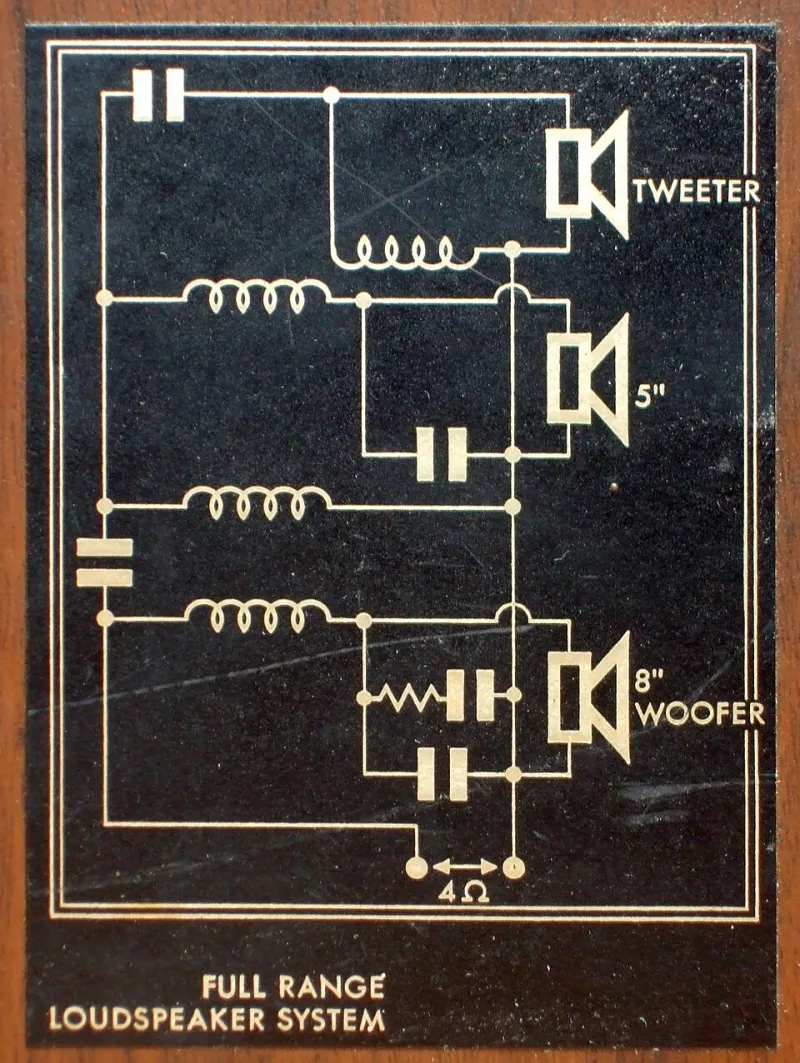
Photo: Piano Piano!, CC BY 2.0, via Wikimedia Commons
Walk into any high-end audio showroom in the United States and you will eventually be handed a specification sheet. On that sheet, somewhere near the top, sits a frequency response figure — typically expressed as something like "40Hz–20kHz, ±3dB." It looks authoritative. It looks complete. It is, in a meaningful sense, deeply misleading.
The frequency response curve is not a lie, exactly. It is, however, an abstraction — a single-dimension snapshot of a speaker's behavior that omits some of the most consequential information a serious listener needs. Chief among the omitted details is the role of the crossover network: the assembly of capacitors, inductors, and resistors that divides the incoming audio signal and routes specific frequency ranges to the appropriate driver. This network is arguably the most influential component in any multi-driver loudspeaker, and it is almost never discussed in the marketing materials.
What a Crossover Actually Does
At its most fundamental level, a crossover exists to solve a physical problem. No single driver can reproduce the full range of audible frequencies with equal accuracy. A woofer cone large enough to move the air required for deep bass cannot vibrate fast enough to reproduce high frequencies cleanly. A tweeter dome designed for delicate upper-register detail would be physically destroyed by low-frequency demands. The crossover acts as a traffic director, sending bass frequencies to the woofer and treble to the tweeter, with a defined transition region — the crossover point — somewhere in between.
The challenge is that this division is never perfectly clean. Filters do not switch frequencies on and off like a light switch; they roll off gradually, following slopes measured in decibels per octave. A first-order crossover rolls off at 6dB per octave. A fourth-order design rolls off at 24dB per octave. The steeper the slope, the more abrupt the transition — but steeper slopes also require more complex filter networks, which introduce their own complications.
The Phase Problem Nobody Talks About
Here is where the specification sheet falls silent. Every filter in a crossover network introduces phase shift — a temporal displacement between different frequency components of the signal. When a woofer and a tweeter are both reproducing frequencies near the crossover point, they are doing so with different phase relationships. If those relationships are not carefully managed, the two drivers can partially cancel each other out, creating a dip in the frequency response that no on-axis measurement fully reveals. Worse, phase anomalies affect imaging and soundstage coherence in ways that listeners often describe as vague or fatiguing without being able to identify the cause.
First-order crossovers, despite their simplicity, are actually the most phase-coherent design available — a fact that accounts for the enduring following of manufacturers such as Vandersteen, whose loudspeakers have employed first-order topology for decades. The tradeoff is reduced driver isolation and the need for drivers with exceptionally wide, flat response curves. Higher-order crossovers offer better driver protection and steeper out-of-band rejection, but they do so at the cost of increasingly complex phase behavior.
Some manufacturers address this through time alignment — physically offsetting the tweeter relative to the woofer so that the acoustic centers of both drivers reach the listener's ears simultaneously. Others employ digital signal processing to correct phase errors in the electrical domain. Most do neither, and their specification sheets offer no indication of which approach has been taken.
Component Quality and the Coloration You Cannot Measure
Beyond topology, the physical quality of crossover components introduces its own set of variables. Electrolytic capacitors, commonly used in budget and mid-range designs because of their cost efficiency, are measurably inferior to film capacitors in their distortion characteristics and long-term stability. Inductors wound with thinner wire introduce series resistance that affects damping and transient response. The iron cores sometimes used in woofer inductors can saturate at high signal levels, generating harmonic distortion that no frequency response curve will reveal.
This is why two loudspeakers with nearly identical published frequency response curves can sound dramatically different during extended listening. One may use air-core inductors and polypropylene film capacitors throughout its crossover; the other may employ electrolytic capacitors and steel-core inductors as a cost-reduction measure. The graphs look similar. The listening experience does not.
For the audiophile willing to investigate further, crossover component quality is one of the most cost-effective areas for loudspeaker upgrade. Many experienced listeners have found that recapping an older, well-designed loudspeaker with premium-grade components yields improvements in clarity and transient response that rival far more expensive equipment purchases.
What to Listen For in the Crossover Region
Identifying crossover-related anomalies during an audition requires deliberate attention. The crossover region — typically somewhere between 1.5kHz and 4kHz in a conventional two-way design — coincides with some of the most critical frequencies in human speech and musical instruments. A piano's upper register, the presence region of a vocalist, the attack of a plucked guitar string: all of these live in the neighborhood of the crossover point.
Listeners evaluating a loudspeaker should pay particular attention to the coherence of midrange-to-treble transitions. Does a vocalist's voice maintain a consistent tonal character as notes move up the register, or does there seem to be a slight change in character at a certain pitch? Does the stereo image remain stable and precisely placed, or does it seem to shift or blur? These are symptoms of crossover-related issues that no frequency response graph will flag.
Sine wave sweeps, available through a number of free audio test applications, can also be revealing. Running a slow sweep through the crossover region while listening carefully for any unevenness, roughness, or apparent change in loudness can expose problems that standard music listening might obscure.
Reading the Specification Sheet More Honestly
None of this is an argument against frequency response measurements. They remain a useful baseline for understanding a loudspeaker's general character. The argument, rather, is for a more complete picture — one that includes information about crossover order, topology, component grade, and phase behavior.
Some manufacturers, to their credit, publish impedance curves alongside frequency response data. Impedance curves can reveal crossover-related anomalies that the frequency response does not, including the reactive loading that complex crossover networks impose on amplifiers. A loudspeaker whose impedance drops sharply in the bass while presenting a highly capacitive load at high frequencies is a loudspeaker that will behave very differently with different amplifiers — another variable the frequency response specification cannot communicate.
The most useful evaluation of any loudspeaker, ultimately, remains extended listening in a controlled environment with familiar program material. Specification sheets are starting points, not verdicts. The crossover network inside a speaker cabinet is doing more work — and exercising more influence over the sound you hear — than any single published figure will suggest. Knowing that it exists, and knowing what questions to ask about it, is the beginning of a more honest conversation about loudspeaker quality.