Watts Are a Lie: The Truth About Amplifier Power and What Actually Drives Great Sound
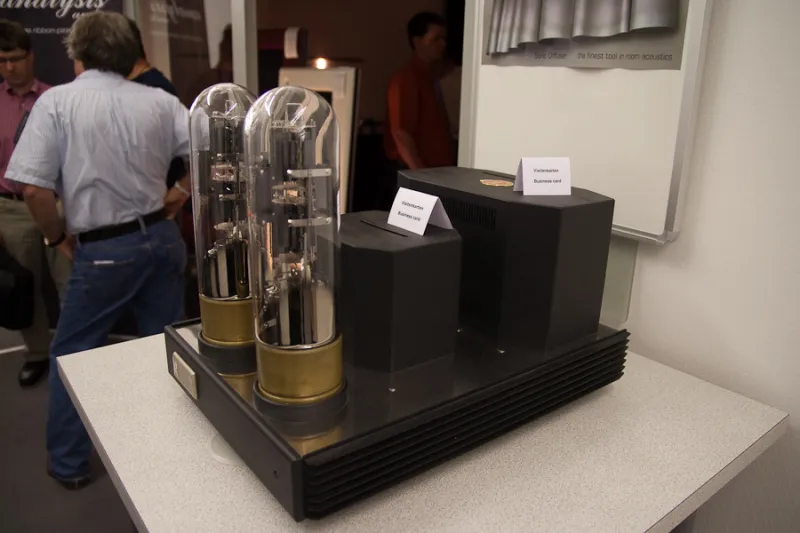
Photo: Christian Herzog, CC BY 2.0, via Wikimedia Commons
Walk into any audio forum in the United States and you will encounter a familiar debate: how many watts is enough? Enthusiasts compare specifications the way car buyers compare horsepower figures, assuming that a higher number translates directly into a superior experience. It is an understandable instinct — wattage is concrete, measurable, and easy to compare across products. Unfortunately, it is also one of the most misleading metrics in high-fidelity audio.
At Hawthorne Audio, we have spent considerable time listening to systems that defy the wattage logic on paper. A 15-watt tube amplifier driving a pair of high-sensitivity horn speakers can fill a living room with authority and presence that embarrasses a 200-watt solid-state unit paired with a demanding planar magnetic design. The reasons behind this apparent paradox are grounded in physics, and once you understand them, you will approach amplifier selection very differently.
The Decibel Math That Changes Everything
Sound pressure level — what we perceive as loudness — does not scale linearly with power. It scales logarithmically. Doubling the amplifier's wattage yields only a 3 dB increase in output. To achieve a 10 dB increase, which most listeners perceive as roughly twice as loud, you need to multiply power by a factor of ten.
Consider a practical scenario. If your speakers produce 85 dB at one watt measured at one meter — a common sensitivity rating for many bookshelf designs — a single watt of clean amplification is already producing conversation-level volume. At 10 watts, you are at 95 dB. At 100 watts, you reach 105 dB, which is genuinely loud for a residential listening room. The leap from 100 watts to 500 watts buys you only an additional 7 dB — and that is before accounting for the acoustic compromises that come with listening at those levels.
Now contrast that with a speaker rated at 99 dB sensitivity, a figure common among certain horn-loaded and some professional-grade designs. A 2-watt amplifier driving that speaker reaches the same output level as a 100-watt unit driving the 85 dB speaker. This is not a theoretical exercise. It is the operational reality that defines why wattage figures, stripped of sensitivity context, tell you almost nothing about system performance.
Impedance: The Variable Nobody Wants to Discuss
Amplifier power ratings are typically published under idealized laboratory conditions — often a steady-state sine wave into a resistive 8-ohm load. Real speakers are not resistive 8-ohm loads. They are reactive, frequency-dependent devices whose impedance fluctuates across the audio spectrum, sometimes dramatically.
A speaker nominally rated at 8 ohms might dip to 3 ohms or lower in certain frequency regions, particularly in the bass. When an amplifier encounters that lower impedance, it must deliver significantly more current to maintain voltage — and current delivery, not wattage, is what strains many amplifier designs. An amplifier rated at 100 watts into 8 ohms might produce only 60 watts into 4 ohms if its power supply and output stage cannot source the required current. A well-engineered 50-watt design with a robust power supply may actually outperform a nominally higher-wattage competitor on a difficult load.
This is why experienced audiophiles and recording engineers pay close attention to amplifier current delivery specifications and damping factor figures rather than fixating on peak wattage. Damping factor — the ratio of speaker impedance to amplifier output impedance — directly affects how well an amplifier controls woofer movement, which in turn shapes bass definition and transient accuracy. A high damping factor generally indicates tighter, more articulate bass reproduction, regardless of the wattage headline.
Listening Beyond the Spec Sheet
To illustrate these principles in concrete terms, consider two listening scenarios we have evaluated extensively.
In the first, a pair of popular American-made bookshelf speakers with a 4-ohm nominal impedance and 84 dB sensitivity were paired with a 250-watt per channel integrated amplifier from a well-regarded domestic brand. The system sounded competent but exhibited a slight hardness in the upper midrange at moderate volumes — a characteristic often associated with an amplifier working harder than its thermal management allows under reactive loading.
The same speakers, connected to a different amplifier rated at 150 watts but built around a more substantial power supply with a demonstrated ability to double current delivery into lower impedances, sounded measurably more composed. Bass lines were better defined, the midrange opened up, and the overall presentation had a solidity that the higher-wattage unit did not provide. The lesson was not that 150 watts is better than 250 watts. The lesson was that power supply architecture and current delivery capacity matter enormously — and these qualities rarely appear on the front page of a product listing.
In the second scenario, a pair of vintage high-sensitivity speakers — 98 dB, 8 ohms — were driven first by a modest 8-watt single-ended amplifier and then by a 120-watt solid-state integrated. Both reached comfortable listening volumes with ease. The lower-powered unit, however, operated well within its thermal and electrical limits at all times, and the result was a palpable clarity and harmonic richness that the solid-state amplifier, running at a fraction of its rated output, did not fully replicate. Speaker sensitivity had essentially neutralized the wattage advantage entirely.
Practical Guidance for the Thoughtful Buyer
None of this suggests that amplifier power is irrelevant. Speakers with low sensitivity or complex, low-impedance loads genuinely benefit from amplifiers with substantial power reserves. Large listening rooms, dynamic music genres, and certain panel speaker designs all present legitimate cases for higher wattage. The argument is not against power — it is against treating power as a proxy for quality.
Before selecting an amplifier, gather three pieces of information about your speakers: their sensitivity rating in dB at one watt per meter, their nominal impedance, and — critically — the minimum impedance they present across the frequency range. Cross-reference these figures against the amplifier's current delivery capability and its behavior under reactive loads. If that data is not available from the manufacturer, consider it a yellow flag.
Also evaluate your listening environment. A well-treated room of average American living room dimensions — roughly 12 by 18 feet — rarely requires more than 50 clean watts into a reasonably sensitive speaker to achieve reference listening levels. The acoustic treatment discussion is one we have addressed separately, but the room's behavior influences how hard your amplifier works to produce perceived loudness, and by extension, how much power you actually need.
The Honest Conclusion
The amplifier market in the United States is crowded with products competing primarily on wattage figures because wattage is easy to advertise and easy to compare. Genuine amplifier performance — the kind that translates into a more engaging, more accurate, more emotionally involving listening experience — is rooted in circuit topology, power supply quality, output stage design, and the match between the amplifier's electrical characteristics and your specific speakers.
More watts can solve certain problems. They cannot compensate for poor current delivery, high output impedance, or a fundamental mismatch between amplifier and speaker. Understanding your system as a whole, rather than chasing specifications in isolation, is the discipline that separates informed listeners from perpetually unsatisfied upgraders. At Hawthorne Audio, we believe that discipline is worth cultivating — because the reward is sound that genuinely satisfies, regardless of what the spec sheet says.