The Quieter the Amplifier, the Louder the Truth
There is a paradox at the heart of high-fidelity amplifier design: the most important thing a great amplifier does is nothing at all. Not the watts it delivers, not the frequency response it maintains, not the distortion figures printed in the brochure — but the quality of its silence. The noise floor, that imperceptible layer of electrical activity present even when no signal is playing, is arguably the single most consequential specification in determining what a listener ultimately perceives as musical refinement.
Most audiophiles have never thought about their amplifier's noise floor in concrete terms. They feel its effects — the sense that a recording breathes, that a piano note resolves completely before the next begins, that a vocalist seems to occupy actual space rather than simply emanate from a cabinet — without recognizing that what they are experiencing is the absence of something rather than its presence.
What the Noise Floor Actually Is
Every electronic amplification circuit generates some degree of unwanted electrical activity. Thermal noise, arising from the random movement of electrons through resistors and transistors, is unavoidable at any temperature above absolute zero. Shot noise emerges from the discrete nature of electrical charge in semiconductor devices. Flicker noise, sometimes called 1/f noise, concentrates at low frequencies and is particularly common in solid-state designs. These phenomena, individually microscopic, accumulate through gain stages until they constitute a measurable signal present at the amplifier's output even when its input is completely silent.
The specification used to quantify this condition — signal-to-noise ratio, or SNR — expresses in decibels the difference between the amplifier's maximum output level and its residual noise. A figure of 90 dB is considered acceptable in modest equipment. Serious high-fidelity designs routinely achieve 100 to 110 dB or better. Elite amplifiers from manufacturers committed to engineering precision can exceed 120 dB. Each ten-decibel improvement represents not a marginal refinement but a tenfold reduction in noise power.
Why the Difference Is Audible — Even When It Shouldn't Be
Here is where the conversation becomes genuinely interesting. A noise floor of -100 dB is, by any rational measure, inaudible during normal listening. The dynamic range of the human auditory system, while remarkable, does not extend to resolving signals buried that far below a musical passage. So why do experienced listeners consistently identify quieter amplifiers as sounding more resolved, more spacious, more emotionally compelling?
The answer lies in masking. Auditory masking is the well-documented phenomenon by which louder sounds suppress the perception of quieter ones occurring simultaneously. A noise floor that cannot be heard in isolation nevertheless interacts with the musical signal passing through it. Low-level harmonic decay — the final moments of a bowed cello string, the tail of a reverberant piano chord, the breath of a singer between phrases — exists precisely at the threshold where noise floor and signal intersect. When that floor is elevated, those delicate structures are obscured. When it drops, they emerge.
In blind listening comparisons conducted with carefully matched output levels, listeners consistently rate amplifiers with lower noise floors as more "open" and "three-dimensional" even when they cannot articulate why. The subjective vocabulary of audiophile criticism — air, blackness, depth, resolution — maps almost perfectly onto what physics predicts when noise floor is systematically reduced.
The Emotional Stakes of Technical Silence
This is not merely an academic concern. Music communicates in the spaces between its most prominent events. The decay of a note, the room acoustic captured in a recording, the breath of a performer — these are the elements that transform reproduced sound into a convincing emotional experience. A noisy amplifier does not simply add a faint hum to your music. It erodes the connective tissue between musical events, replacing nuance with a kind of auditory flatness.
Consider a recording like Keith Jarrett's Köln Concert, where the extended decay of the piano in a reverberant hall is as musically significant as any note Jarrett plays. On an amplifier with a compromised noise floor, that decay shortens perceptually. The hall shrinks. The performance loses the quality of existing in a real space. On an amplifier with a genuinely low noise floor, the recording's acoustic environment becomes palpable, and the performance acquires a dimension of presence that justifies the entire enterprise of high-fidelity audio.
How to Evaluate Noise Floor Without a Laboratory
Few audiophiles have access to Audio Precision test equipment. But practical evaluation of an amplifier's noise floor is not impossible. The most straightforward approach: set the amplifier to normal listening volume with your most efficient speakers connected and no signal playing. Place your ear close to the tweeter. A competently designed amplifier should be essentially silent. Any audible hiss, hum, or texture is a warning sign.
For a more revealing test, play a well-recorded acoustic track you know intimately and attend specifically to the moments after musical events — the final decay of struck percussion, the silence following a vocal phrase. If those moments feel abrupt or opaque, if the recording seems to stop rather than resolve, the noise floor may be masking information that is genuinely present in the source.
When auditioning amplifiers side by side, resist the temptation to evaluate only during the loudest passages. The differences that matter most reveal themselves in quiet music and in the silence between notes.
The Design Choices That Determine Silence
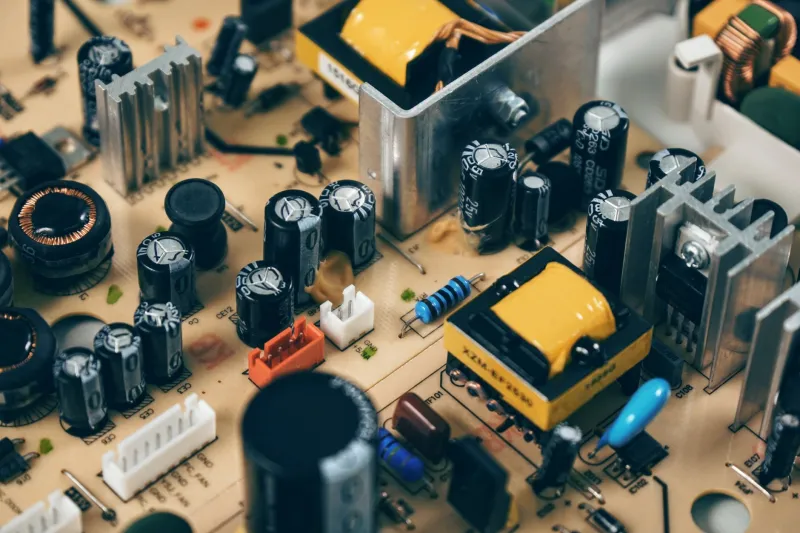
Achieving a genuinely low noise floor requires deliberate engineering decisions at every stage of amplifier design. Power supply quality is paramount: a poorly filtered power supply injects noise directly into the signal path, and no amount of circuit sophistication downstream can fully undo that damage. Component selection matters — precision resistors, low-noise operational amplifiers, and carefully chosen transistors each contribute to the aggregate noise performance of the finished design.
Layout and shielding decisions are equally consequential. Noise from digital sources, switching power supplies, and radio-frequency interference can couple into an amplifier's circuit through proximity alone. Manufacturers who take noise performance seriously invest in chassis design, ground plane topology, and component placement with the same rigor they apply to their gain stages.
That investment is audible. Not as a feature you can point to, but as a quality of listening that makes extended sessions feel effortless and emotionally rewarding rather than subtly fatiguing. The quieter the amplifier, the more completely it disappears from the chain between you and the music — and that disappearance is, ultimately, the highest achievement any amplifier can claim.